What Is Melanoma
Melanoma is a form of skin cancer that arises from melanocytes - the cells that produce pigment. Melanoma may begin in association with a mole. Melanocytes produce a pigment called melanin that gives the skin its colour and protects it from sun damage. Darker skin has more melanin and more protection. Melanocytes often cluster together and form moles (nevi). Most moles are benign, but some may go on to become malignant melanomas.
Images:
Click on any of the Melanoma images below to enlarge. Go to Melanoma Images page.
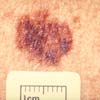
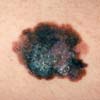
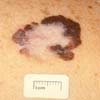
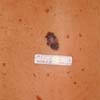
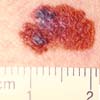
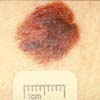
Melanomas are divided into 4 main types, depending on their location, shape and whether they grow outward or downward into the dermis:
Superficial Spreading Melanoma
This often begins as a flat dark stain on the skin or appears as a change to a pre-existing mole. It accounts for 2/3 of all melanomas.
Nodular Melanoma
This is usually unrelated to a pre-existing mole. A smooth nodule appears, and it is often blue-black in colour – it may grow rapidly and spread to the lymph glands quickly.
Acral Lentiginous Melanomas
This occurs on the palms of the hand, on the soles of the feet or under nail beds, and can grow and spread quickly. In dark-skinned people it accounts for most of melanomas.
Lentigo Maligna Melanoma
This is quite common on chronically sun-exposed skin and usually appears on the face of elderly people.
Video:
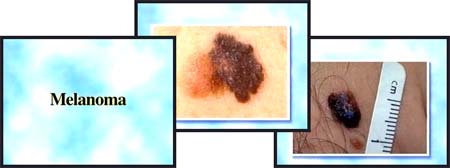
Please view a short video (82 seconds) on what Melanoma looks like. The video is available in three formats:
Click the above links to open the movie in a new window, or right-click and choose "Save Target As" to save the video to a location on your computer so you can view it offline.
Stages of Melanoma progression:
In situ melanoma
The earliest form of melanoma, it is small and does not extend beneath the surface of the skin
Stage I melanoma
Tumours are less than 2mm in thickness, found in the outer layer of the skin (epidermis) and/or the upper part of the inner layer of the skin (dermis)
Stage II melanoma
The carcinoma spreads to the lower part of the inner layer of the skin (dermis) but not into the tissue below. It can spread into fat tissue as well.
Stage III melanoma
The carcinoma spreads to nearby lymph nodes.
Stage IV melanoma
The carcinoma spreads beyond the skin to distant sites or organs
Melanoma can also start in the mucous membranes of the mouth, anus and vagina, in the eye or other places in the body where melanocytes are found. See Other Skin Cancers for more information.
(Some material, facts, and figures have been adapted from The BC Cancer Agency (www.bccancer.bc.ca) and The Canadian Cancer Society (www.cancer.ca).
Related Articles
 Summer Sun and Melanoma
Melanoma is a very serious form of skin cancer that can be fatal if not caught early on. The good news is that it can be curable if it is detected and treated in its early stages...
More Skin Cancer Articles...
|